


Why every quantum milestone moves the bottleneck somewhere else
Quantum computing is becoming harder to judge at the exact moment it is becoming more credible. For years, the simplest way to track progress was to count qubits: more qubits implied a larger, more capable machine. That shortcut was never entirely accurate, but it was adequate for an industry still proving it could build and control large quantum processors in the first place. The better question now is not how many qubits a system has, but where its constraint sits, because that constraint keeps moving.
Quantum computers have struggled with the same basic problem for two decades: quantum states are fragile and decay over time through a process called decoherence, while every operation performed on a qubit introduces some additional probability of error. As systems grow and computations become longer, those errors have more opportunities to accumulate. Without effective error correction, adding more hardware therefore does not automatically produce a more reliable computer.
Error correction changes what scale actually means. Once many of these fragile physical qubits can be combined to detect and correct each other’s errors, rather than simply adding more raw capacity, the relevant question is no longer how many qubits a machine has. It becomes how efficiently that machine converts those physical qubits into logical qubits. A logical qubit is a more reliable unit built by combining many physical qubits, one that can actually be trusted to compute correctly. This makes logical qubits a better measure than physical qubits, though still not a perfect one. A logical qubit that merely preserves information is not equivalent to one capable of executing long sequences of genuine operations, and two machines with the same logical-qubit count may require very different amounts of hardware, time, and control to reach that point.
Quantum computing continues to solve one problem only to reveal the next one behind it. Resolve the hardware’s raw error rate, and error correction becomes the constraint. Resolve error correction, and how operations are scheduled and executed becomes the constraint. Resolve that, and manufacturing and control infrastructure become the constraint. Every one of these, eventually, resolves into an economic question: can the machine perform something valuable at a lower cost than the best classical alternative?
Reliability changes the scoreboard
Quantum error correction, or QEC, is where the old scoreboard first breaks down. Rather than relying on a single fragile qubit to preserve information, QEC distributes that information across many physical qubits, allowing errors to be detected and corrected without directly observing the protected state. Below a certain error threshold, adding more physical qubits to this encoding makes the system more reliable rather than more fragile.
Google’s Willow chip is one clear illustration of this shift. Using 101 physical qubits arranged in an error-correcting configuration, it achieved a logical error rate of 0.143% per correction cycle, with reliability improving further as the configuration was scaled up. For a sense of scale, that logical qubit remained accurate roughly twice as long as its best individual physical qubit. It also lasted about twenty times longer than the comparable result on Google’s own previous chip, Sycamore, a useful yardstick for how much ground a few years of engineering can cover. The notable figure here is not the qubit count. It is that adding more hardware made the system more reliable rather than less.
The pattern is not specific to superconducting hardware. Trapped-ion and neutral-atom systems have each published their own below-threshold results in Nature this year, Quantinuum with an up to 800-fold reduction in logical versus physical circuit error rates, QuEra with 96 logical qubits from 448 atoms, using the same underlying principle of spreading information across additional physical qubits. These results are not directly comparable to each other, but three architectures built on entirely different physics are converging on the same conclusion: reliability is a property of the system’s encoding, not a fixed property of the underlying qubit. The practical stakes are straightforward. A lower error rate allows more operations before accumulated errors overwhelm the result. That budget of reliable operations, not how impressive a single result looks on paper, is what determines which algorithms are even possible to attempt.
This also illustrates why counting logical qubits can become just as misleading as counting physical ones. Different companies employ different error-correcting codes, cycle times, connectivity assumptions, and definitions of what a logical qubit is expected to accomplish. Some approaches require fewer physical qubits per logical qubit but demand substantially more complex connectivity to achieve it. A system can appear excellent at preserving information while remaining slow or costly when it comes to actual computation. A system with fewer logical qubits can therefore still be the more capable one, provided its operations are meaningfully faster or more reliable.
The question that matters is not how many logical qubits a company can claim. It is what those logical qubits can actually execute: at what error rate, for how long, and at what cost in hardware and time.
Useful computation moves the bottleneck outward
Once storing information reliably is no longer the constraint, computation becomes the next one. A commercially useful algorithm must execute a long sequence of operations before accumulated errors overwhelm the result, and that depends on far more than the qubits themselves: the speed and accuracy of each operation, how quickly errors are corrected in real time, and how efficiently the system prepares and routes the resources each operation requires. These are properties of the machine as a whole, not of any individual qubit.
Google’s Willow illustrates this coupling clearly. Its real-time decoder operated with an average latency of roughly 63 microseconds, while the processor generated a new error-correction cycle every 1.1 microseconds. The decoder did not need to complete every calculation before the next cycle began, but the gap still shows that fault tolerance depends on classical control and decoding scaling alongside the quantum hardware.
This is why comparing systems using a single metric becomes less useful as the field matures. Fast operations can be offset by heavy error-correction overhead. High accuracy can be offset by slow operations. Stronger qubit connectivity can reduce routing overhead but require more complex control systems. The relevant progression runs from physical qubits, to error correction, to logical operations, to an executable workload, with losses introduced at every stage.
Benchmarking is beginning to reflect this shift. The Quantum Universal Operations Performance System (QUOPS), introduced by Sandia National Laboratories with input from Quantinuum and NVIDIA, measures both the size of a successful computation and the effective rate of operations, incorporating the real-world overhead of error correction, decoding, and routing along the way. Early results already give the gap a number: on problems such as factoring a 2048-bit RSA key, current hardware falls short of the estimated threshold by roughly five orders of magnitude, a hundred-thousand-fold gap. It is too early to treat QUOPS as an industry standard, and application-specific benchmarks will still matter. What matters more is what it already measures: the output of the whole system, not what any single component can claim independently.
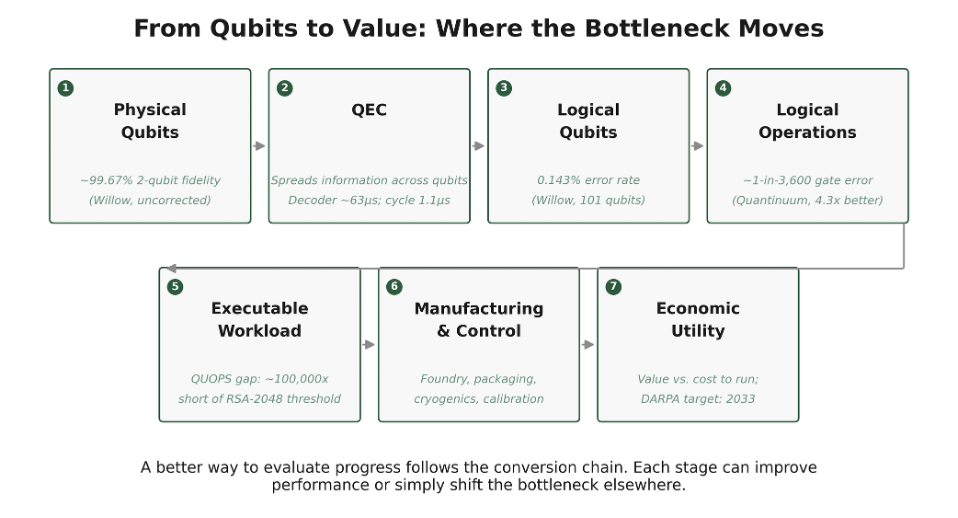
Figure 1. The system conversion chain in quantum computing.
This same logic changes how different types of quantum hardware should be compared, and the five main approaches below are pursued by different groups of companies. Each one trades a specific advantage for a specific scaling burden: faster operations for harder cooling, higher accuracy for slower control, larger arrays for heavier optical overhead.
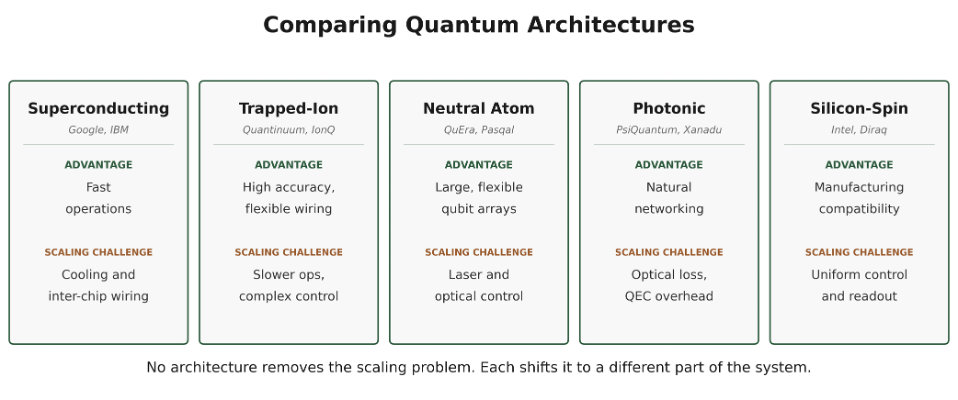
Figure 2. Illustrative primary advantage and scaling challenge by architecture. Tradeoffs vary by implementation and continue to evolve.
No approach eliminates the scaling problem entirely; each merely shifts it elsewhere. This matters more than ranking these approaches by whichever benchmark currently looks most favorable, because the constraint limiting a system at one hundred qubits is often different from the constraint limiting it at ten thousand or one million.
The relevant question is straightforward: if this architecture scales by an order of magnitude, what becomes the new bottleneck, and does the design make that bottleneck easier or more difficult to resolve?
Industrialization turns technical progress into a capital question
At small scale, a quantum system can tolerate custom-built parts, hand-tuned calibration, and limited-batch manufacturing. At commercial scale, it cannot. The wiring must fit precisely. Thermal load must remain manageable. Optical systems must stay aligned across repeated runs. Every component must be reliably reproducible rather than an isolated success. The classical electronics responsible for reading and correcting the system must scale as well, without eroding the gains achieved at the qubit level.
This is why foundry access, advanced packaging, cryogenic electronics, and automated calibration are increasingly integral to the quantum computer itself, rather than merely supporting infrastructure around it. Describing them as ‘supporting infrastructure’ understates their importance. If any one of them scales poorly, it can become the dominant cost or performance constraint even as the underlying qubit technology continues to improve.
This has meaningful implications for how capital efficiency should be assessed. Quantum hardware will remain capital-intensive, but burn rate alone reveals little about how efficiently that capital is being deployed. A company can appear efficient today while carrying a substantial future obligation to industrialize fabrication and control. Conversely, a competitor may appear expensive simply because it is already spending to retire manufacturing or integration risk that a peer has merely deferred.
This is also why comparing two companies at the same financing stage can be misleading. One may have already demonstrated repeatable fabrication and scalable controls, while the other still depends on processes that function only in a laboratory setting. The relevant question is never how much capital has been raised. It is what that capital has actually proven.
Capital efficiency should be measured by the amount of genuine risk retired, not by remaining runway. Does the next dollar reduce the eventual cost of useful computation, or does it merely defer the same bottleneck further down the road?
The commercial endpoint is economic utility
Eventually, all of this technical progress must resolve into an economic answer. The industry still lacks a single accepted way to measure whether a quantum computer is genuinely useful, because usefulness depends entirely on the task and on how capable the best classical alternative is at that same task. Chemistry, optimization, and cryptographic workloads each demand different combinations of scale, depth, and accuracy. This is why a claim of ‘quantum advantage’ can be technically accurate within one narrow test while indicating little about commercial value.
Even a technically scalable system still needs a workload worth running. Willow’s own Quantum Echoes result cleared a real verification bar in Nature, but Google’s own researchers still put real-world applications at roughly five years away, a timeline worth holding next to DARPA’s 2033 target below. Hardware progress has to be judged against both the best classical alternative and the maturity of the application chasing it.
DARPA’s Quantum Benchmarking Initiative offers a useful framework for the underlying measurement problem, because it does not define success by a fixed qubit threshold. Instead, it evaluates whether an architecture can plausibly reach utility-scale operation, meaning computational value that exceeds cost, by 2033. The program assesses the full system and the engineering risk required to build and operate it, rather than assuming that progress in one component guarantees a useful machine.
That is, in effect, the investor’s endpoint as well. A machine does not become commercially significant because it reaches a million physical qubits or a thousand logical qubits. It becomes significant the moment it can execute something valuable reliably enough, quickly enough, and cheaply enough that its output is worth more than the system required to produce it.
The industry is not yet at the point where a single metric can replace qubit count. Physical error gives way to error correction, error correction gives way to logical operations, and logical operations expose limits in control and manufacturing.
The architecture that ultimately scales will not necessarily be the one that solves today’s bottleneck first. It will be the one that keeps clearing the next bottleneck without the cost climbing every time. Qubit quality still matters, but it answers a narrower question than it used to. What will matter is whether a company can keep outrunning its own bottleneck, all the way to a machine whose output is worth more than what it costs to build and run.