
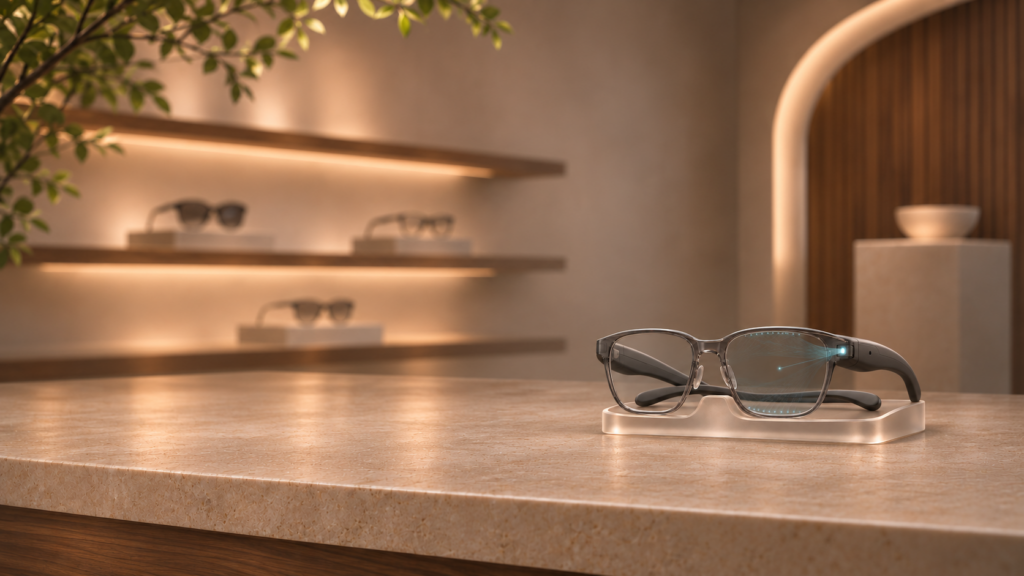

The optics in AR glasses discard most of the light their displays produce. That one loss explains what every product on the market gives up, and why the next step depends on the display chip.
When Meta showed its Orion prototype glasses in 2024, it said the projectors hidden in the frame could put out hundreds of thousands of nits. A nit is a unit of brightness, and a bright phone screen in sunlight manages a few thousand. The person wearing Orion sees 300 to 400.
Hundreds of thousands go in and a few hundred come out. Where that light goes explains most of what you can and cannot buy in smart glasses today, and why so much of the industry’s effort now goes into a chip smaller than a fingernail.
Following the light
A pair of see-through AR glasses has three stops between the picture and your eye.
The first is the light engine: a tiny display chip, usually tucked into the arm or the corner of the frame, that draws the image. The second is the lens, which in most designs is a waveguide: a thin piece of glass that carries the picture from the edge of the frame to the front of your eye while staying clear enough to see through. The third is the eye itself.
Most of the loss in brightness happens in the lens. A projector on its own forms an image you could only see from one exact spot, like looking through a keyhole. But eyes move, faces differ, and glasses slide down noses. So the waveguide copies the image many times and spreads the copies across a patch of lens wide enough that one of them always lands in your pupil. Your pupil is a few millimeters across. Every copy that lands outside it is wasted, on top of the light lost each time the image is bounced, split or redirected on its way through the glass.
The result is that very little survives. Diffractive waveguides, which steer light with microscopic gratings and are the type Orion uses, typically pass only a few percent of the light that enters them at best, and wide-view, full-color or high-transparency designs can fall well below one percent. Reflective waveguides, which use rows of tiny partial mirrors instead, are several times more efficient for the same field of view, but have historically been harder to make in volume.
At the other end, the eye is competing with the world. Indoors, a few hundred to a thousand nits reaching the eye is enough for crisp text. Outdoors it is not: analysts put the floor in daylight at a few thousand nits reaching the eye. Work that requirement backwards through a lens that passes a few percent of its light, or less, and the chip has to produce tens of thousands of nits at a minimum, and for a wide view through a diffractive waveguide, far more.
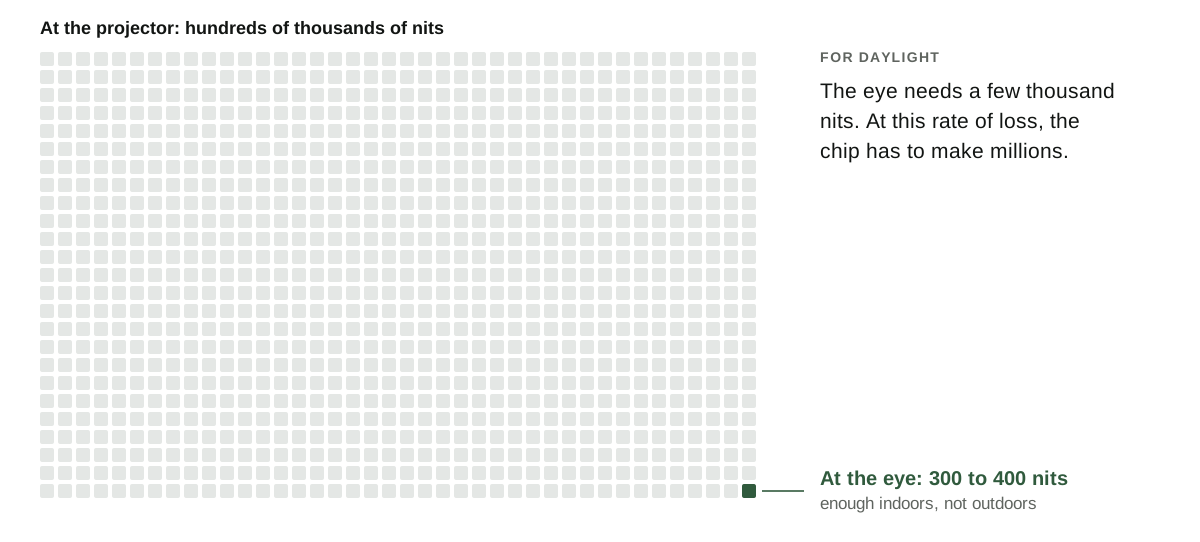
Meta Orion, 2024. Each square is one thousandth of the brightness at the projector. The ratio is approximate, since Meta gave the projector figure only as hundreds of thousands of nits.
Every pair of glasses gives something up
Because the budget is so tight, no product on sale or announced manages all five of the things people want: bright enough for daylight, full color, a wide enough view to show more than a notification, light enough to wear all day, and a consumer price. Each one gives up at least one of them.
The six products below were chosen to show the main ways companies are spending that budget today, one clear example of each: shrink the image; show a single color; go wide with everything in the frame; go wide with the computer on a cable; go wide with custom parts at prototype cost; or replace clear lenses with cameras.
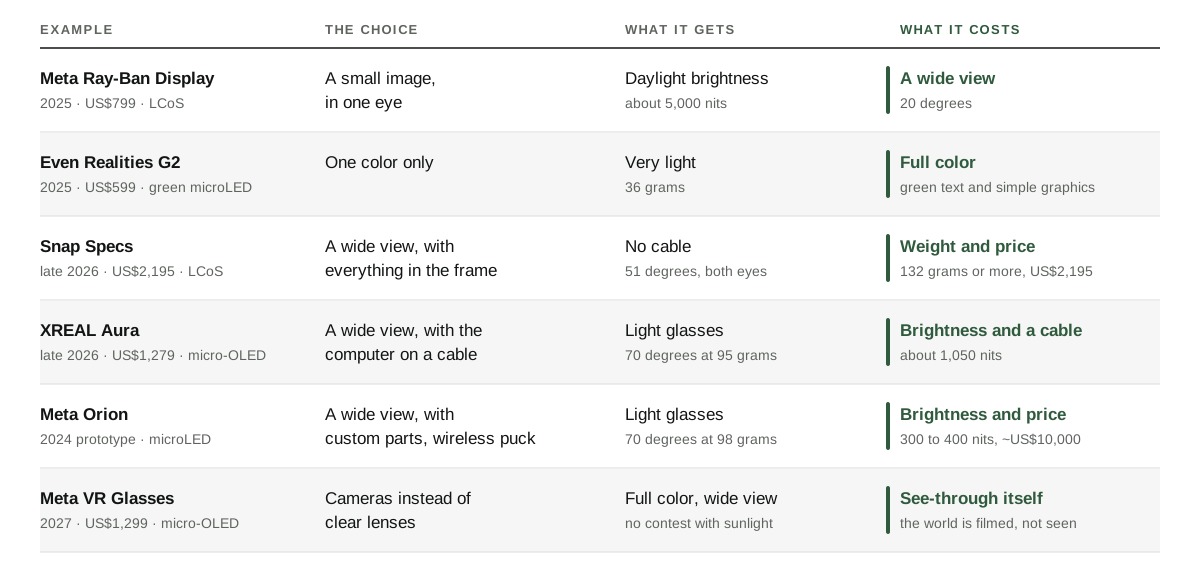
One current example of each design choice, what it gets, and what it costs; Meta VR Glasses also stands in for Apple Vision Pro and Samsung Galaxy XR. Figures as published by each company, except Ray-Ban Display brightness, which is from an independent measurement.
Each choice has a direct cost. A small image concentrates the light: Ray-Ban Display reaches daylight brightness with a 20-degree image and, according to teardowns, the more efficient reflective type of waveguide. Showing a single color keeps text glasses under 40 grams. Going wide spreads the light over a much larger image, and the two wide see-through designs that publish their brightness show the result: Orion delivers 300 to 400 nits and XREAL’s Aura, glasses that run Google’s Android XR operating system, about 1,050. Both keep the glasses light by moving the computer and battery into the wearer’s pocket: Aura on a cable, Orion over a wireless link, with custom parts such as silicon carbide lenses that put each prototype at about US$10,000. Snap keeps everything in the frame instead and pays in weight and price; it has not published a brightness figure. Passthrough steps out of the contest with sunlight altogether: Apple, Samsung and now Meta, whose VR Glasses weigh about 100 grams, film the world with cameras instead of letting it through the lens.
Where the budget can be fixed
There are two ways out: make the lens waste less, or make the chip much brighter. Waveguides are improving, but the larger lever is the display chip, and there are four kinds in serious use.
LCoS (liquid crystal on silicon) is a layer of liquid crystal on a silicon chip that acts as a fine-grained shutter for light from a separate LED. It is mature and inexpensive, and it is the workhorse of the full-color thin AR glasses on sale today. Its weakness is that it blocks light rather than making it, so black is never fully black. In see-through glasses, where dark pixels are supposed to be invisible, that shows up as a faint gray rectangle floating in your view. The separate light source also takes up space in the frame.
Micro-OLED puts a layer of organic light-emitting material on a silicon chip, so every pixel makes its own light and black is truly black. It is the display inside Vision Pro and Galaxy XR. For years it was considered too dim for slim waveguide glasses, and in see-through glasses it has so far appeared mainly in designs that do not use a waveguide, such as XREAL’s, which deliver roughly 600 to 1,050 nits to the eye depending on the model: comfortable indoors, short of daylight. That is changing quickly: Samsung Display demonstrated a 20,000-nit panel in May 2025 and a 40,000-nit panel in June 2026, and INT Tech has announced demonstration panels it says reach 150,000 nits.
Laser beam scanning draws the image by sweeping a laser beam back and forth with a tiny mirror. It is compact, and designs that scan directly onto the retina can keep the image sharp wherever the eye focuses, at the cost of a very small viewing window. But laser light produces a grainy sparkle called speckle, and any system that points lasers at the retina has to prove it is safe.
MicroLED uses an array of microscopic inorganic LEDs, one per pixel, made from the same family of materials as LED light bulbs. It is extremely bright and long-lived, which makes it the leading candidate for wide-view glasses that work outdoors. Single-color microLED already ships in lightweight glasses that show green text; full-color microLED is still mostly in developer kits and pilot products.
For now, microLED has the most headroom and micro-OLED is improving fastest, and it is too early to call either the winner.
MicroLED’s color problem
MicroLED’s difficulty is color. To match the sharpness of the eye, glasses need pixels less than about five micrometers apart, a twentieth of the width of a hair, and at that size red loses most of its efficiency: etching such small devices damages their edges, and the smaller the pixel, the more of it is edge. A 2024 review in APL Materials reported efficiencies of around 0.1 percent for very small red devices of the conventional kind, against roughly ten percent for small blue ones.
Even with good red, fitting three colors into one projector is hard. Combining three single-color chips with a prism makes the projector bulky, and placing millions of red, green and blue LEDs side by side on one chip, a step known as mass transfer, is a yield problem.
So companies divide by how they get color. Some grow all three colors natively and work on red. Some make one color and convert part of it into the others, accepting some leakage of the original light and a conversion layer that must survive high brightness. Others tune a single LED across colors, which is hard on the driving electronics and on heat.
How to read a display number
For an investor, the useful lesson from all of this is how easy it is to quote a display number in a flattering place. The distance between what a chip can do and what an eye receives is so large that the same product can be described with figures a thousand times apart, all of them accurate. Four questions help.
Where was it measured? At the chip, or at the eye, and through which kind of lens? Orion’s projectors and Orion’s wearer differ by something like a factor of a thousand. The same applies to contrast: the LCoS chip in Ray-Ban Display is rated at 1,000 to 1 on its own, while independent measurement of the whole system found about 600 to 1.
At what drive level? Every light-emitting material has a drive level where it is most efficient, and efficiency falls away on either side of it. A figure measured at the material’s best point says little about behavior at the brightness glasses actually need outdoors. The useful answer is a curve across drive levels, not a single point.
For how long? Brightness records are usually announced without lifetime data. Glasses need thousands of hours at high brightness. The question is what fraction of the original brightness remains after a given number of hours at operating level.
At what pixel size, and in what volume? A result achieved with 20-micrometer pixels does not automatically carry over to five; red efficiency is the clearest example. Yield on a handful of demonstration panels is a different number from yield on a production line.
Anything that places a laser or other high-energy light source a few centimeters from the eye should also come with an answer on safety, including what happens when a part fails.
Where this leaves the market
Every product in the table is a different way of spending a light budget set mostly by the lens. Ending the trade-off takes one of two things: a lens that wastes far less light, or a chip bright enough to cover the loss in full color, at pixel sizes small enough for glasses. On the chip side, the two leading technologies each have half of the answer. MicroLED has the brightness and is still solving color. Micro-OLED has the color and is still proving that its brightness lasts.
The constraint is already shaping the market. Meta and EssilorLuxottica sold about seven million smart glasses in 2025, and their display model arrived only at the end of that year, in a limited set of US stores, so most of that volume had no display at all. Samsung’s first glasses on Google’s Android XR platform, made with Warby Parker and Gentle Monster, take the same route.
For glasses that do show an image, we expect the market to split by setting. Indoors, for media and desk work, passthrough has the easier path: it never has to compete with sunlight, and its old drawback, weight on the head, is shrinking. Meta’s VR Glasses put about 100 grams on the face, a fifth of a Quest 3, by moving the computer and battery into a pocket unit on a cable. Outdoors and all day, only see-through glasses will work, and in the near term they will come in two forms: full-color glasses like Ray-Ban Display, with LCoS, a reflective waveguide and a small image, and single-color microLED glasses like Even Realities’ G2 for text. The wide, full-color, see-through glasses that work in daylight most likely need full-color microLED and more efficient waveguides, with micro-OLED as the credible alternative if its brightness proves durable. In technology terms, that means LCoS and reflective waveguides in the near term, full-color microLED in the long run, and micro-OLED as both the main challenger and the display of choice for the newest passthrough devices.
Commercially, the scarce layer is the display engine: the chip and the optics that carry its light. The platforms have treated it that way. Apple acquired the microLED developer LuxVue in 2014, and Google acquired Raxium in 2022. For startups in this layer, acquisition by a platform is a realistic outcome, and the teams best placed for it are the ones whose numbers hold up at the eye, at full brightness, over time.
Whichever technology closes the gap first will set the shape of the category, because it will make possible the first pair of glasses that gives up none of the five.