
Many of the most visible commercial failures in synthetic biology have occurred after proof of concept. Four gates stand between an engineered molecule and a durable business, and they do not age at the same rate.
Over the past several years, several well-capitalized engineered-biology companies have wound down production, restructured, or quietly narrowed their ambitions. In a number of these cases the science had worked. The target molecule was produced, the pathway was assembled and expressed, and demonstration batches reached real customers. The difficulties appeared later: in the fermenter, on the cost sheet, and inside the customer’s qualification process.
That pattern suggests diligence is often aimed at the wrong stage. A company that takes a molecule from concept to shipment passes through four gates in sequence: the molecule, the strain, the tank, and the buyer. Each eliminates a portion of the field. They are set out in sequence because that is how diligence proceeds, though development itself is iterative: buyer requirements and downstream economics frequently push teams back into strain and process design.
The gates are also different in character, not only in difficulty. The first two lean more heavily on knowing what to build. The second two depend more on accumulated practice and commercial position.
Gate 1: The molecule
The first question is not whether a molecule can be made biologically. For a wide and growing class of natural products, it can. The more useful question is what the molecule is competing against, and this is where the analysis often goes wrong.
The intuitive comparison is between two ways of supplying the same compound, agricultural extraction against fermentation. On that comparison fermentation frequently looks decisive, since it decouples supply from weather and growing region, delivers batch consistency within validated limits, and can reach compounds a plant accumulates only in trace amounts.
But a choice between two sources is a sourcing question, and sourcing questions arise only once someone has decided to buy the molecule at all. In most cases the buyer has not.
A formulator selecting an anti-inflammatory active is not choosing between two sources of one compound. They are choosing from a shelf of established actives, such as niacinamide, centella and bisabolol, that are inexpensive, well characterised, widely accepted in their markets, and already designed into products that sell. A novel active competes against that shelf, and the elegance of its supply chain does not enter the comparison.
Choosing correctly here is difficult, and companies that get it right are exercising judgment rather than luck. But the difficulty is informational, and that works against the company that goes first in two ways. The answer becomes visible once that company raises capital, publishes, and begins selling into a category, so a later entrant inherits both the choice and the verdict, and can wait until demand has been demonstrated. The pioneer also carries the timing risk. A company whose process is built around one molecule, or one closely related family, is underwriting that family’s adoption curve as well as its own execution, and strong process economics do not compensate if the category arrives five years late.
Ask: what does the buyer use today, and why would they change? The answer is sometimes that they do not currently need the ingredient at all, and that answer is easier to obtain at this stage than at any later one.
Gate 2: The strain
This is the gate most pitches dwell on, and it is probably not where the defensibility lives. Once a molecule has been made this way and described, one expensive uncertainty, whether a biological route can work at all, is reduced for everyone who reads it. Patents narrow the field without closing it: in the United States a naturally occurring molecule is generally not patentable in its own right, so protection is more likely to attach to the engineered host, the pathway components, the process steps, or a formulation, derivative or use than to the molecule in isolation. A competitor arriving by another path may reach the same target molecule, even where its process history, impurity profile and qualification status remain different. What the second team still does not have is a process that runs at a price. That is a different problem, and the subject of the next gate.
Ask: how long would a well-resourced team need to reach a functional equivalent, and how much of what actually works here is written down anywhere?
Gate 3: The tank
At this gate the character of the problem changes, and so does how long clearing it protects the company.
Results at bench and small-reactor scale are generally easier to control and to reproduce. What changes at commercial volume is not that new physics appears, but that the usual fixes stop being affordable. At ten litres a team can hold dissolved oxygen up with harder stirring and purer gas; at a hundred thousand litres the same interventions run into equipment limits, shear, heat removal and cost. Heat that was trivial to remove becomes a constraint, the contents stop behaving as one well-mixed vessel, feedstock arrives in industrial lots, and recovery losses are counted against real mass. All of it acts directly on unit economics, and several of them interact, so the failure mode is rarely a single tractable problem.
This helps explain why some failures become visible only after substantial capital has been raised. Capital is raised on demonstrated science and a modelled cost curve. The curve is then invalidated by behaviour that only appears at volume, and the remaining runway funds process development that had been assumed complete.
Clearing this gate also produces knowledge that does not travel easily, which is the first place the difference between the gates shows up. A published paper or granted patent may disclose the enzymes, the host and the broad sequence of steps. Neither will tell a competitor what dissolved oxygen window to hold in a thirty-thousand-litre vessel, when to shift the feed, or which impurity appears late in a run and how to remove it. That knowledge tends to exist only in a team with accumulated operating experience across development and commercial batches. It is frequently undocumented even internally, and it is protected in practice by not being written down rather than by being registered, which is why advantages of this kind are slow to build and slow to erode.
There is a caution for companies that have already cleared it. Passing this gate converts a technical risk into a commercial one, because dedicated fermentation capacity is concentrated and expensive to leave idle, and even where a contract facility can be reconfigured, changeover, cleaning and revalidation limit how freely it can be repurposed. A plant that runs is a cost advantage; the same plant at low utilisation is a fixed charge against gross margin. Utilisation is determined at the fourth gate rather than the third, so scale demonstrates that a company can manufacture without yet demonstrating that anyone is buying.
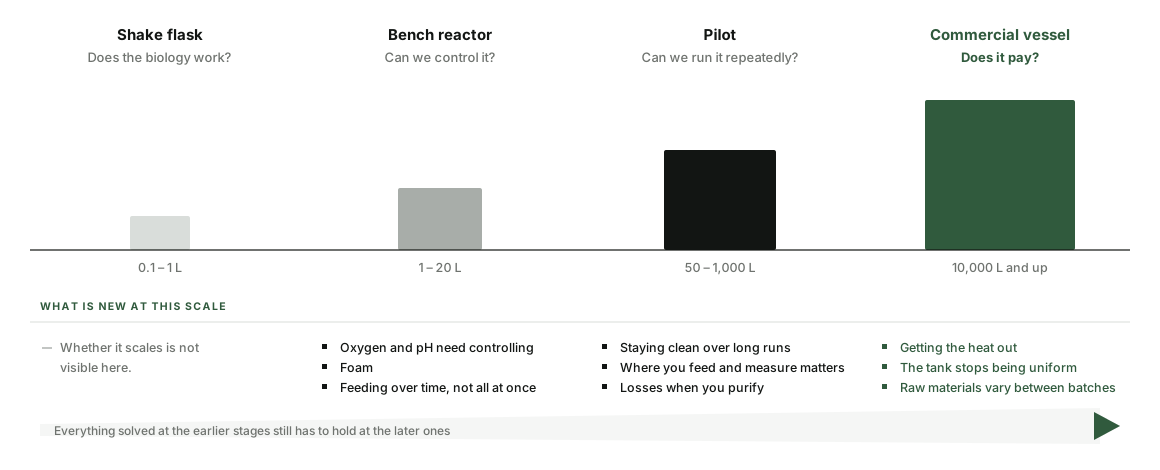
Ask: which scale steps has this process actually run, what changed at each one, and what utilisation does the cost model assume?
Gate 4: The buyer
Two chemically identical molecules are not commercially identical inside a customer’s system. Changing supplier can require re-running stability studies, updating regulatory filings, and requalifying a formulation, a process measured in quarters or years and largely outside the seller’s control. The first commercial interaction is usually a sample request; repeat orders are where commercial validation begins.
That friction is normally described as a cost, which captures only half of it. It may also be the most durable position available in this field. A supplier already written into a customer’s specification, whose material has passed that customer’s stability and safety work, is not easily displaced by a marginally cheaper equivalent, because the buyer would have to reopen a process they have little reason to reopen. A patent may protect a way of making or using the molecule. A place in the specification protects the sale of it, and that is closer to what the pioneer is actually paid for.
This gate is strategic rather than merely slow because its clock speed differs sharply by segment, which turns the choice of entry segment into a capital-efficiency decision rather than a marketing one.
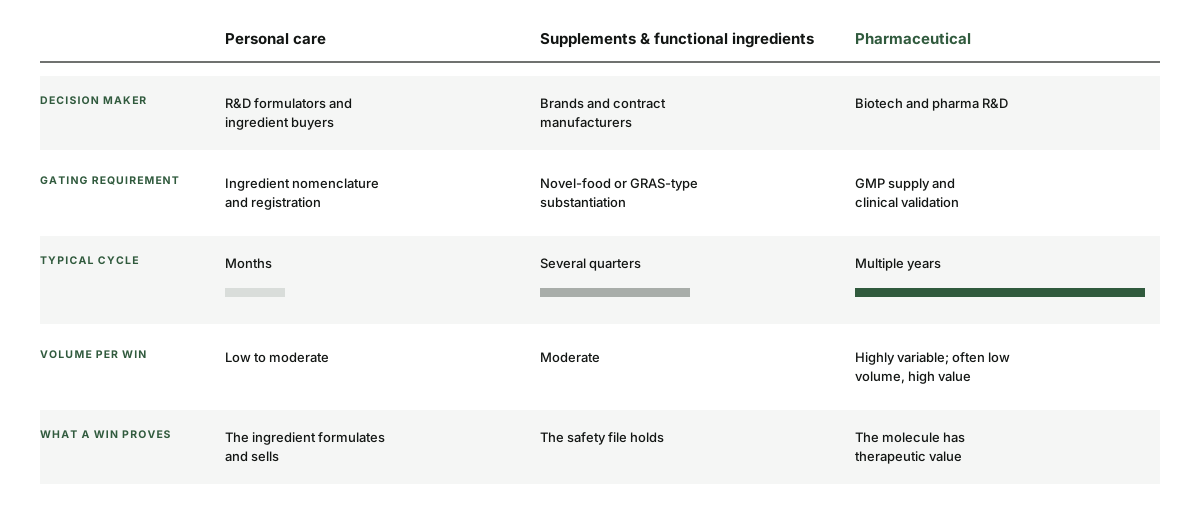
The sequence therefore matters as much as the choice. Personal care often offers a relatively fast route to initial revenue and to a reference customer, though those volumes rarely fill an industrial plant. Pharmaceutical programmes can support strong margins and long-lived contracts, but whether they justify large fermentation capacity depends on dose, patient numbers, titre and downstream yield, and they pay out on a timeline most venture structures are not built to wait for. Entering only at the slow end can be scientifically right and still run short of capital; entering only at the fast end may never reach the margin the capital structure requires.
Nothing at this gate is fully under a company’s control, and regulation is the clearest case. A rule change can qualify or disqualify a whole class of supply on a date set by someone else, without any company doing anything, and it can move in either direction. A current US hemp rule illustrates both directions at once. New total-THC thresholds, most of which are scheduled to take effect in December 2026, may favour material produced without THC rather than remediated down to a limit. At the same time, language excluding cannabinoids synthesized or manufactured outside the plant creates a separate uncertainty over whether fermentation-derived cannabinoids qualify as hemp at all, since the statute defines neither term. The advantage created by one clause may be removed by another.
Ask: which segment is this company entering first, whose specification is its material already written into, and does that sequence match the shape of its capital?
What survives being known
The four gates come in a familiar order, but they do not hold equally well once passed.
The first two are largely problems of information. Choosing the right molecule is difficult, and the answer becomes public as soon as the company succeeds visibly. Building the strain is difficult, but difficulty is not the same as exclusivity. Once the route is known to work, a patent protects what its claims cover, and depending on their breadth, alternative hosts, enzymes or process architectures may remain open to a competitor. Both advantages are real, and both can be documented, which is part of why they tend not to last.
The second two are problems of practice and position. Much of what a team learns across repeated batches at scale is not written down anywhere a competitor can readily reach. A position inside a customer’s approved specification is not transferable by reading either. It reflects a qualification decision, and a competitor needs the customer to have a reason to reopen it.
The useful question is probably not whether the yeast can make the molecule. It is whether the company’s advantage is of a kind that survives being known.